

Innovation Expedition: Flexible Testing of New Drone Payloads
Leonita Avdyli, Innovation, armasuisse Science and Technology
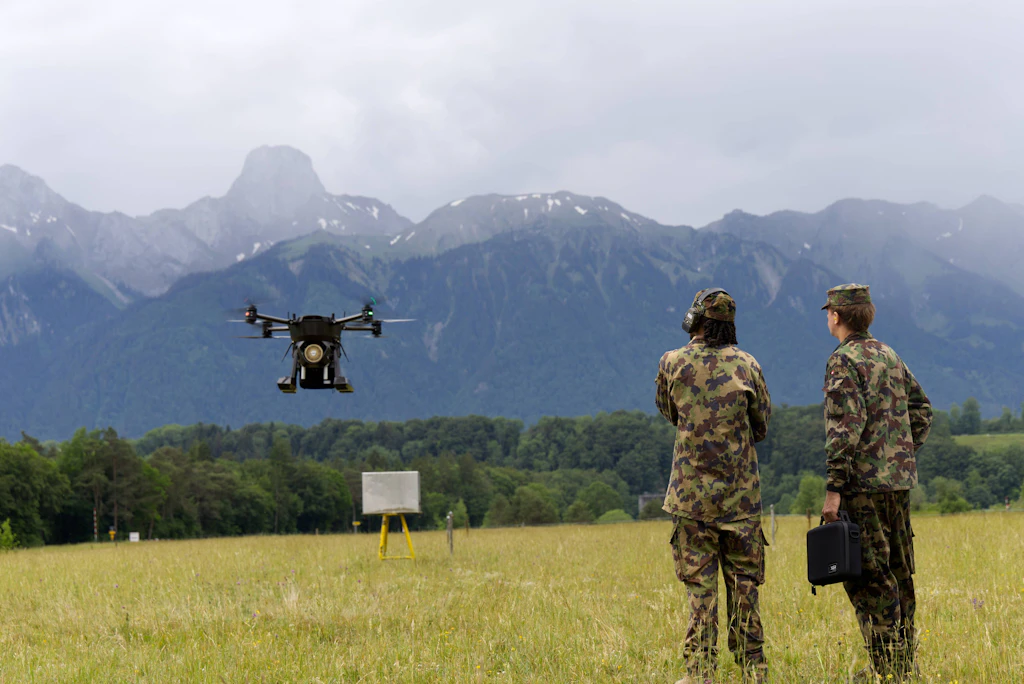
What tasks could transport drones take on within the Swiss army in future? The Defence Centre of Competence for Drones and Robotics (Komp Zen DRV), the Logistics Brigade and armasuisse Science and Technology (S+T) are addressing this question as part of an Innovation Expedition.
Together with armasuisse S+T, it was decided to undertake the Expedition in the ‘Test Run’ Innovation Space and to evaluate potential operational scenarios step by step.
The ‘Test Run’ Innovation Space offers the opportunity to test technologies in practice and to assess their benefits at an early stage and in concrete terms. These technologies have a solution maturity level of 8 (beta solution) to 9 (available solution with confirmed requirement fulfilment).
A versatile drone technology
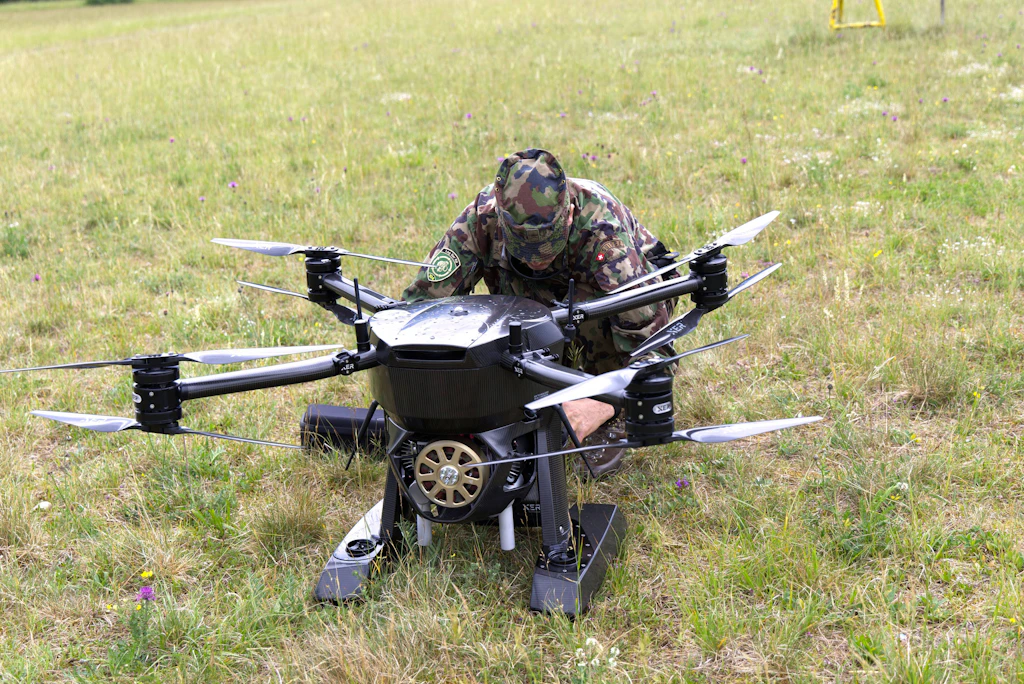
At the heart of the project is a modular transport drone that serves as a carrier platform for various payloads. This means that, depending on requirements, the drone can be equipped with different devices, such as cameras or transport containers, and thus be deployed for a variety of tasks. The transport drone is fitted with a hybrid propulsion system that combines the advantages of battery and internal combustion technology. This enables longer operational times and greater flexibility across different requirement profiles. A transport drone developed in Switzerland is being used for the trials. As part of the innovation Expedition, the aim is to investigate the scenarios in which this type of drone could offer added operational value.
The work is not focused on procuring a specific system, but rather on testing potential use cases. For example, the study will examine whether the drone is suitable for transporting larger goods over longer distances or for the rapid delivery of smaller goods close to the operational site. It will also assess the types of terrain where the use of a drone could offer advantages over other transport options.
A key advantage of the modular transport drone is that it can be used as a carrier platform for different payloads. This means that a dedicated drone or a separate test system does not have to be developed or procured every time new trials are conducted. Instead, the same transport drone can be equipped with different devices as required and deployed for various applications. Furthermore, due to its high payload capacity, several communication systems can be carried simultaneously. This provides redundancy in signal transmission and thus increases the reliability of communication.
Conclusion and outlook
The Innovation Expedition provides targeted support to carefully selected commands of the Swiss Army that wish to expand their use of drone systems for their respective tasks in future. At the same time, collaboration with industry partners helps to drive forward innovation in the field of drone technology in a targeted manner. An important milestone has already been reached: the first training session using the system took place with members of the Logistics Brigade 1 in the summer of 2026.
The Defence Centre of Competence DRV has drawn a positive conclusion: “The instructor impressed with his experience gained from numerous guided flight hours and was able to convey the key content efficiently in a short space of time.” The insights gained in the process form the basis for further tests and the gradual evaluation of new use cases.